California ADU Laws Impact in Dana Point and San Clemente
The California ADU laws impact on high-end real estate in Dana Point and San Clemente is becoming harder to ignore. What used to be a simple luxury home purchase is now turning into something larger. Many buyers are no longer just looking at the main house. They are also looking at how much extra space the lot can support, what kind of future use the property allows, and how the land can serve a family for many years.
In the past, coastal luxury usually meant a big home, ocean views, strong design, and a great address. Those things still matter. But in 2026, buyers are paying more attention to flexibility. They want homes that can work for parents, adult children, guests, caregivers, or private staff. They also want options for rental income and long-term planning. That is why the new ADU rules matter so much in these coastal cities.
An ADU, or accessory dwelling unit, is a smaller secondary home built on the same property as a main home or residential structure. These units can be detached, attached, or created from converted space. What makes the recent law changes important is that they open the door for more units in some cases and reduce delays that used to slow projects down. This change is especially important in expensive coastal markets, where land is limited and every square foot matters.
For Dana Point and San Clemente, this is not just a zoning story. It is a value story. It is also a lifestyle story. High-end buyers are starting to view larger lots as places where they can create private family compounds instead of just owning one luxury home with an oversized yard. That shift is changing the way people think about land, privacy, and long-term use in South Orange County.
Why these law changes matter more in coastal luxury markets
In many parts of California, ADU reform has mostly been discussed as a housing issue. In Dana Point and San Clemente, the conversation is different. Here, the same legal changes can affect luxury values because the underlying land is already so expensive. When rules become more flexible, the value of that land can rise faster.
A large lot in a premium coastal city already carries strong value because of its location. But when that lot gains the legal ability to hold more housing units, its usefulness grows. Buyers may see the property as a place for multigenerational living, added income, long-term estate planning, or even private housing for employees. That broader use can make the property more attractive to a wider group of wealthy buyers.
This is where the idea of the “legacy compound” comes in. In simple terms, a legacy compound is a property that can support more than one household while still feeling private and upscale. Instead of one home trying to do everything, the property can be divided into separate living spaces. A grandparent can live close by without losing independence. An adult child can stay local in a separate unit. A live-in assistant or caretaker can have housing on-site. Guests can visit without taking over the main house.
That kind of setup has strong appeal in expensive coastal cities, where buying several separate homes nearby may be unrealistic even for affluent families. The result is that ADU laws are not just changing building rights. They are changing what luxury ownership can look like.
The move from one estate to a family compound

The old model of a luxury coastal estate focused on one primary home. The main goal was prestige, privacy, and appearance. Large lawns, guest rooms, and outdoor living spaces all supported that idea. But the new model is more practical. It still values beauty and privacy, but it also values function.
Today’s buyer often wants a property that can solve real-life problems. Family members are living together longer. Parents may need care later in life. Young adults may need a place to stay as they save money. Owners may want rental income without giving up their main home. These needs are pushing buyers to think differently.
That is why some luxury buyers now look at a property and ask questions like these:
- Can this lot support more than one detached unit?
- Can family members live here without feeling crowded?
- Can I create income from part of the property?
- Can I hold this home as a long-term family asset?
- Can this property become a private retreat for several generations?
In high-cost coastal communities, the answers to those questions can influence value just as much as views, finishes, or architecture.
How SB 1211 changes the picture
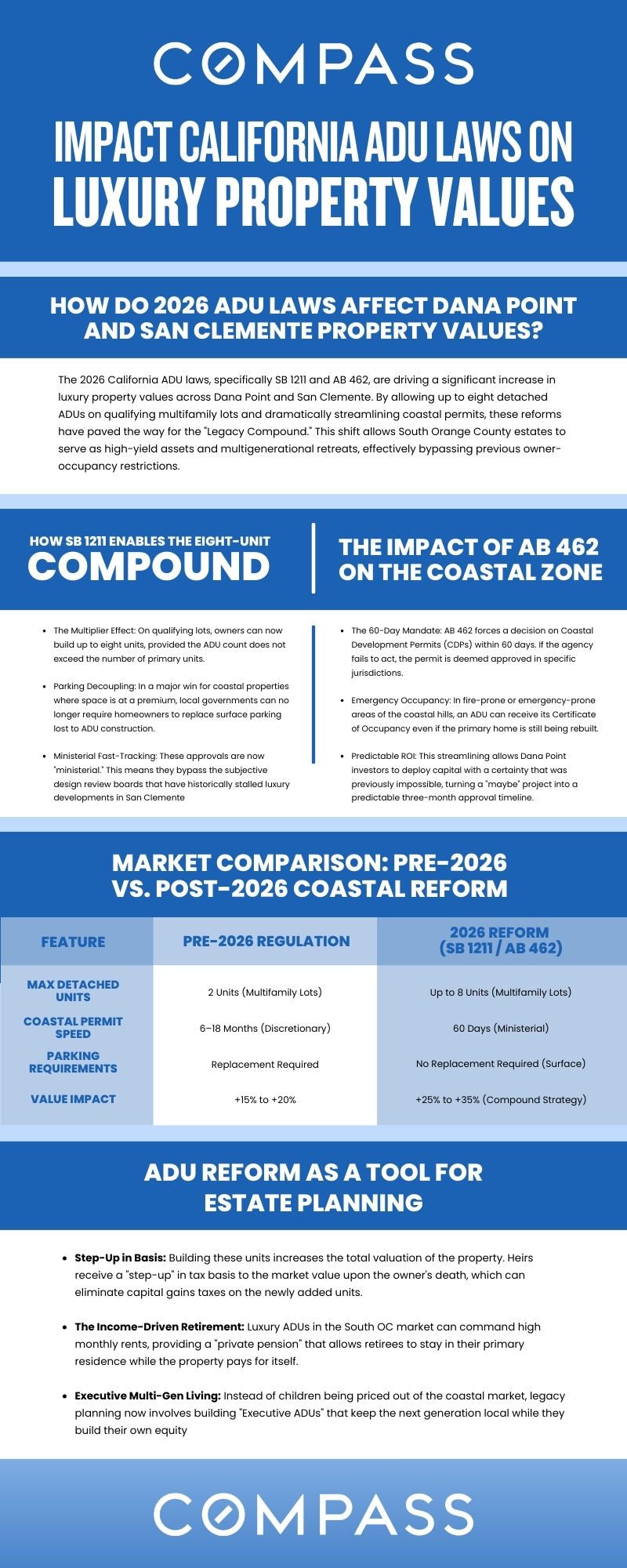
SB 1211 is a major reason this shift is happening. Based on the information provided, this law increases the number of detached ADUs allowed on qualifying multifamily lots. That change is important because it creates much more development flexibility than before.
Before this reform, multifamily properties had a much smaller limit for detached ADUs. After the reform, qualifying properties may be able to support up to eight detached units, depending on the number of primary units already on the site. That is a dramatic jump.
Here is why that matters:
- It increases the possible use of large residential lots.
- It makes some underused land far more productive.
- It gives owners more ways to plan for family, staff, or rental income.
- It can improve resale appeal for buyers who think long-term.
The law also appears to reduce parking barriers. In expensive coastal areas, parking rules can stop owners from building because they must replace every lost parking space. If those replacement rules are loosened for surface parking, owners gain more room to work with. On constrained lots, that can make a project possible when it otherwise would have failed.
Another key point is ministerial approval. That means approval is more objective and less dependent on subjective design review. In simple terms, if a project meets the legal standards, it has a clearer path forward. That matters because long reviews, uncertain hearings, and design disputes often discourage owners from moving ahead.
What AB 462 means for the Coastal Zone
AB 462 is especially important because Dana Point and San Clemente include properties in or near the Coastal Zone. In the past, coastal permitting could be a major headache. Even modest ADU proposals could face long wait times and uncertainty.
According to the information provided, AB 462 creates a 60-day timeline for decisions on some Coastal Development Permits. That kind of deadline matters. When owners and investors know that a permit process is supposed to move faster, planning becomes easier.
This kind of reform can affect value in several ways:
| Area of Impact | Older Coastal Process | Newer Coastal Reform Effect |
|---|---|---|
| Permit timing | Often long and uncertain | Faster and more predictable |
| Project risk | High because of delays | Lower because timing is clearer |
| Cost control | Harder to manage | Easier to estimate |
| Buyer interest | More limited | Broader because the value is easier to see |
| Return on investment | Less certain | More measurable |
For investors and owners, speed matters almost as much as permission. A project delayed for many months can lose money, create stress, and scare away buyers. A faster process gives people more confidence. That confidence can lift demand.
The emergency occupancy point also matters. In a region where fires and emergency rebuilding concerns exist, the ability to occupy an ADU while a main home is still being rebuilt can add a layer of security. Buyers may see that as practical value, not just legal detail.
How many adus are allowed in California on qualifying lots?
A common question is how many adus are allowed in California under these newer reforms. Based on the information you provided, qualifying multifamily lots may allow up to eight detached ADUs, as long as the ADU count does not go beyond the number of primary units. That is a major change compared with the older limit of two detached units on multifamily lots.
For luxury buyers in Dana Point and San Clemente, this matters because it changes how they view certain parcels. A lot that once seemed oversized may now seem full of opportunity. The land is no longer just an extra yard area. It may become part of a larger long-term strategy.
Pre-2026 vs. post-2026 comparison
The table below shows the broad shift simply:
| Feature | Pre-2026 Regulation | 2026 Reform |
|---|---|---|
| Max detached ADUs on qualifying multifamily lots | 2 units | Up to 8 units |
| Coastal permit timeline | Often 6 to 18 months | Around 60 days in certain cases |
| Parking replacement for lost surface spaces | Often required | No replacement required in certain cases |
| Approval style | More discretionary | More ministerial |
| Luxury value effect | Moderate lift | Stronger lift tied to compound use |
This table helps explain why the market may react strongly. The laws do not just add paperwork changes. They can change how buyers price land and future potential.
Why value may rise in Dana Point and San Clemente

There are several reasons these law changes may support higher values in these two cities.
1. More use of the same land
In a premium coastal market, land is scarce. If owners can do more with one parcel, that parcel may become worth more.
2. Better fit for multigenerational living
Families often want to stay close without sharing the same main house. ADUs can solve that problem.
3. Added income potential
Luxury ADUs may create rental income or flexible guest housing, which makes ownership easier to justify.
4. Stronger estate planning appeal
A property that can serve many purposes may become a better long-term family asset.
5. More buyer types
A home that appeals to both lifestyle buyers and income-focused buyers may attract stronger demand.
ADUs as part of estate planning
For wealthy owners, ADU development is not only about today’s needs. It can also be part of estate planning. A property with multiple living spaces may support family wealth in ways a single home cannot.
Here are a few practical reasons:
- Heirs may inherit a more valuable and more flexible property.
- Family members can stay local without buying another expensive home nearby.
- Owners may create income while still living on the property.
- The estate becomes more useful, not just more impressive.
This is one reason the California ADU laws impact reaches beyond design and construction. It affects how families think about wealth, inheritance, and staying rooted in South Orange County.
Income potential and retirement planning
Another reason ADUs matter is income. In high-demand coastal markets, a well-designed secondary unit can command strong rent. For some owners, that can work almost like a private retirement stream.
Instead of selling a long-held home, an owner may choose to stay in the main residence and use the additional units for income. That can help cover taxes, maintenance, insurance, or daily living costs. In a place like Dana Point or San Clemente, where property costs are high, that extra income can make a big difference.
This idea also helps explain the growing interest in South Orange County legacy compounds. People are not just building for today. They are thinking about how one property can support several generations and several financial goals at once.
Lifestyle benefits beyond money
Not every buyer cares most about income. Some care more about privacy, convenience, and peace of mind. ADUs can support those goals, too.
A coastal compound may offer:
- Private housing for aging parents
- Separate space for returning adult children
- Guest quarters that do not interrupt the main home
- Housing for a caregiver, nanny, or property manager
- A quiet work-from-home space away from the main house
These are real lifestyle advantages. In luxury markets, convenience often carries serious value. Buyers are willing to pay more for a home that makes family life easier.
Risks and limits buyers should still consider

Even with these law changes, buyers should not assume every property can become a perfect compound. There are still practical issues to review.
Important things to consider include:
- Lot size and shape
- Existing structures on site
- Coastal location and local conditions
- Utility access and upgrades
- Construction costs
- Privacy between units
- Neighborhood compatibility
- Local interpretation of state rules
This means the best opportunities are likely to be properties with both legal flexibility and good physical layout. Not every parcel will deliver the same result.
Simple buyer checklist
If a buyer wants to judge ADU potential in Dana Point or San Clemente, this checklist can help:
- Is the property on a qualifying lot?
- Is there enough space for detached units?
- How close are neighboring homes?
- What are the utility and access conditions?
- Does the site support privacy between units?
- Is the location desirable for family or guest use?
- Would the added units improve long-term value?
- Could the property function as a legacy estate?
The bigger meaning of coastal reform
The phrase coastal adu legislative reform effects may sound technical, but the real meaning is simple. These legal changes are making coastal land more flexible, more useful, and in many cases more valuable. That is a major shift in a place where land has always been one of the most precious assets.
Dana Point and San Clemente stand out because they combine a limited coastal supply with strong lifestyle demand. When a market already has prestige, and the law suddenly allows more use on the same land, values can move in a meaningful way.
That does not mean every property will jump overnight. But it does mean buyers, sellers, and investors are starting to think about coastal luxury in a new way. They are asking not just what the home is, but what the property can become.
Final thoughts on the California ADU laws impact
The California ADU laws impact in Dana Point and San Clemente goes far beyond adding small guest houses. It is changing the meaning of luxury ownership in these coastal markets. A high-end property is no longer judged only by the main residence, the view, or the finishes. It is also judged by flexibility, future use, and family planning potential.
For many owners, the real value now lies in turning one large parcel into something more useful, private, and lasting. That is why the California ADU laws impact is becoming a serious factor in luxury property values. In the years ahead, buyers looking at South Orange County may increasingly see top-tier coastal estates not just as homes, but as long-term family compounds built for income, privacy, and legacy.